
On This Page
Google Ads relies on AI to do most of the day-to-day campaign work automatically. Behind the scenes, it adjusts how much you pay for each click in real time, figures out the real intent behind a person’s search, and tests different combinations of your ad text.
With tools like AI Max, it goes a step further—finding additional relevant searches, customizing your ad copy, and sending each user to the landing page most likely to convert them. Today, small businesses might reasonably ask:
Why is it still so easy to waste money on Google Ads?
The answer isn’t that Google’s AI doesn’t work. The problem is that AI can only optimize around the goals, data, budget, targeting, and website experience it is given.
A campaign can hit all of Google’s performance goals and still cost you money — bringing in leads that never buy, clicks from the wrong searches, or conversions that cost more than they’re worth.
For small businesses, effective Google Ads optimization therefore requires something AI cannot completely replace.
Google Ads AI Is an Optimizer, Not a Business Strategist
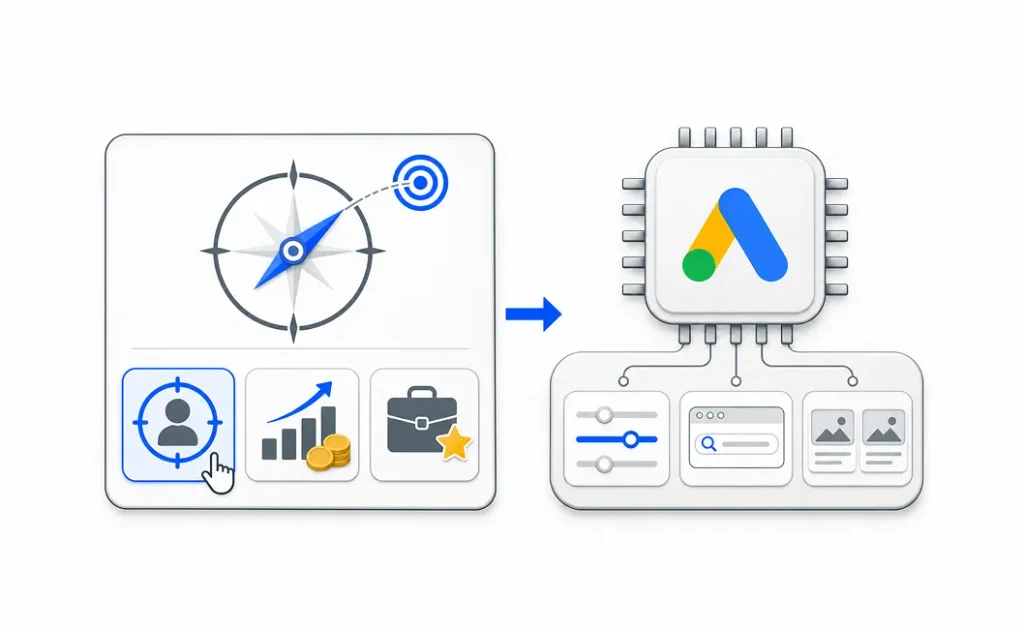
Google’s advertising system can process far more signals than a person could reasonably evaluate for every auction. Smart Bidding considers contextual signals and adjusts bids automatically.
AI Max for Search finds extra searches beyond your keywords, tailors your ad copy, and sends clicks to the landing page it deems most relevant — and it’s now on by default for new Search campaigns.
Google’s AI knows what you tell it to optimize for. It does not automatically understand which customer is most profitable, which service you would rather sell, which leads your sales team considers poor quality, or whether increasing volume at a particular CPA actually makes financial sense for your business.
If the campaign’s objective is poorly defined, automation can become very efficient at pursuing the wrong outcome. That is why Google Ads for small business still needs strategy before automation.
[Also Read: Understanding Click-Through Rate: What’s Considered a Good CTR?]
Poor Conversion Tracking Teaches AI the Wrong Lesson
Consider a local service business receiving 30 form submissions from Google Ads. Google sees 30 conversions. But the business may see something very different.
Perhaps ten enquiries are outside the service area. Eight are looking for a service the company doesn’t provide. Five never respond. Four are price shoppers. Only three become genuine sales opportunities.
If every form submission is sent back to Google as an equally valuable conversion, Smart Bidding has little reason to distinguish between the three strong leads and the other 27.
This creates one of the most expensive forms of wasted ad spend: optimizing for activity instead of business value.
Google specifically supports feeding deeper lead outcomes back into its advertising system. Enhanced conversions for leads, for example, can send qualified or converted lead information from a CRM back to Google Ads. The quality of the output improves when the quality of the input improves.
AI Can Expand Reach, but That Makes Search-Term Control More Important
One of Google’s biggest uses of AI is understanding searches beyond a tightly controlled keyword list.
Broad match can connect advertisements with related searches based on meaning and intent. AI Max goes further by combining broad match with keywordless matching and signals from ads, keywords, and landing pages.
For advertisers, this can uncover valuable searches they may never have thought to target manually. But wider reach also makes oversight important.
A roofing contractor may want residential roof replacement leads but not employment searches, DIY instructions, material suppliers, training programs, or unrelated repair questions. Google provides search-term reporting precisely because advertisers still need to understand the actual searches triggering their ads. Irrelevant searches can then be excluded with negative keywords.
AI can discover demand. The advertiser still needs to decide which demand is worth paying for.
A Bigger Budget Cannot Fix a Bad Campaign Structure
When campaigns underperform, one tempting response is to increase the budget. But Google Ads budget optimization is not simply about spending more.
A small business with a limited monthly budget may divide that money across too many campaigns, services, locations, audiences, or experiments. Each campaign then receives too little meaningful data or budget to perform consistently. The opposite problem can happen too.
A business may allow one automated campaign to absorb most of the budget simply because it produces the highest volume of recorded conversions—even when another service generates fewer but substantially more profitable customers.
Google itself notes that AI Max may not work effectively when a campaign is limited by budget. The solution is not to blindly increase spending. Businesses first need to ask what deserves the budget.
- Which services have the strongest margins?
- Which locations convert best?
- Which products have enough inventory?
- Which customer types generate repeat business?
- Which campaigns are bringing revenue instead of merely leads?
AI can allocate spend against a target. Humans still need to make sure the target reflects the business’s economics.
[Also Read: How To Build Retargeting Workflows for Higher Conversions?]
Cheap Leads Can Be More Expensive Than Expensive Leads
Cost per lead is one of the easiest Google Ads metrics to understand. It can also be misleading. Imagine Campaign A generates leads for $40 each while Campaign B generates leads for $75.
At first glance, Campaign A appears to win. But suppose only 5% of Campaign A’s leads become customers, compared with 25% from Campaign B.
The “expensive” campaign may actually be producing much more profitable growth. This is why successful Google Ads optimization should move beyond CPC, CTR, and even raw conversion counts.
The real questions are closer to:
- What percentage of leads are qualified?
- What percentage become customers?
- How much revenue do they generate?
- What is the customer acquisition cost?
- What happens after the Google Ads conversion?
Without those answers, an automated bidding system can optimize numbers that look good inside the Google Ads dashboard while producing disappointing results in the actual business.
The Landing Page Can Waste the Click After Google Finds the Right Person
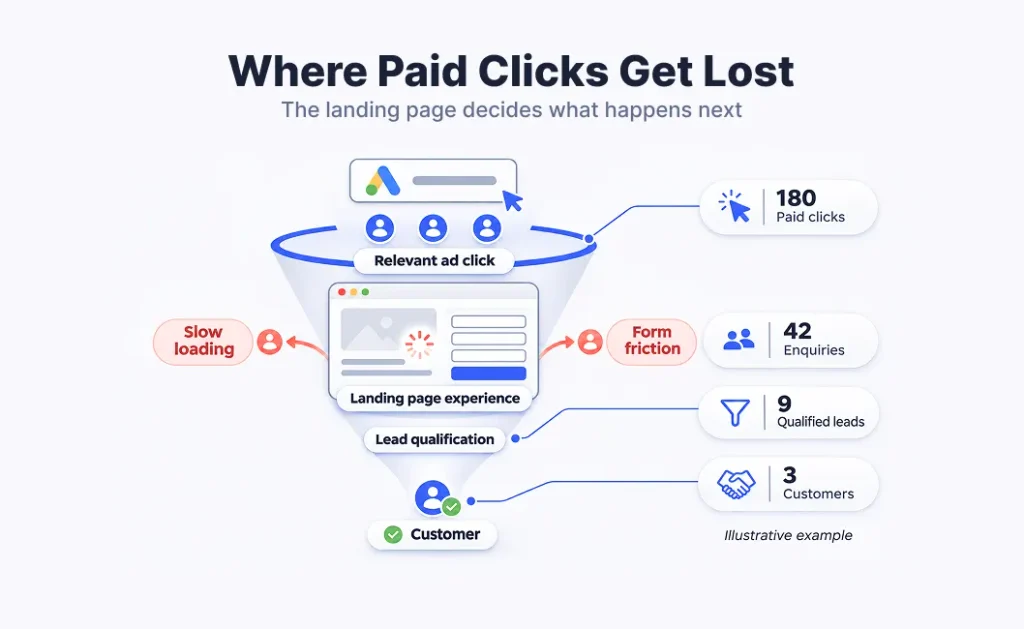
Sometimes targeting isn’t the problem at all. The right person searched for the right service, Google served the right ad, and the business paid for the click. Then the visitor reached the website.
The page loaded slowly. The headline didn’t match the advertisement. The service wasn’t clearly explained. The contact form asked for too much information. The call-to-action was difficult to find. Or the visitor wasn’t given enough proof to trust the company.
That advertising spend is still wasted. Google’s automation can help determine which users are more likely to convert, but it cannot make a weak offer compelling or transform an unconvincing landing page into a strong sales experience.
This is why PPC optimization cannot stop inside the Google Ads account. Ad message, search intent, landing-page message, offer, trust signals, mobile usability, and conversion path all need to work together.
Sometimes the best Google Ads budget optimization decision has nothing to do with changing bids. It is improving what happens after the click.
Automation Still Needs Guardrails
As Google Ads becomes more automated, advertisers may assume they need fewer controls. In practice, strong automation often requires better controls.
AI Max, for example, gives advertisers controls around brands, locations, URLs, search matching, and generated assets. Google also continues to support negative keywords and other steering mechanisms alongside AI-powered campaigns.
These controls matter because automation is designed to explore opportunities. Your business has to define the boundaries of that exploration.
A business may need to exclude services it doesn’t want to promote, locations it cannot serve, pages that shouldn’t receive paid traffic, brand terms that distort acquisition reporting, or search themes that produce low-quality leads.
Giving AI flexibility does not mean giving it unlimited freedom. The goal is controlled automation.
“Set It and Forget It” Is Still a Bad Google Ads Strategy
Machine learning needs time to learn, so constantly changing campaigns can create its own problems. But the opposite extreme—launching an automated campaign and rarely reviewing it—can be just as costly.
Search behavior changes. Competitors change their offers. Prices change. Conversion rates change. Seasonality affects demand. Landing pages get updated. Products go out of stock. Sales teams discover that certain types of leads are consistently poor.
Google’s AI does not automatically know all of that business context. An effective optimization process should therefore keep evaluating whether campaign activity still aligns with real business outcomes.
- Search-term patterns need reviewing.
- Conversion tracking needs verifying.
- Lead quality should be compared with campaign data.
- Budgets should move toward profitable opportunities.
- Creative and offers should be tested.
- Landing-page performance should be evaluated.
- Automation settings should be changed when the evidence supports it.
The marketer’s role is shifting from manually controlling every bid to giving automated systems better instructions, better data, and better boundaries.
So, Is Google AI Actually Good for Small-Business Advertising?
Absolutely—when the foundation is right. Google’s AI can analyze auction signals at a scale that manual campaign management could never reproduce. Smart Bidding can optimize individual auctions, and newer features such as AI Max can extend targeting and creative optimization much further.
Google says advertisers using AI Max typically see increased conversions or conversion value at comparable CPA or ROAS, although individual campaign results will naturally vary. But automation is not the same thing as accountability.
Small businesses still need to know what a valuable conversion looks like, which customers matter most, how much those customers are worth, what searches should be excluded, and whether the website converts paid traffic effectively.
That is the missing piece behind much of today’s Google Ads wasted spend.
Better AI Starts With Better Inputs
The question is no longer whether businesses should use AI in Google Ads. AI is already deeply integrated into how modern campaigns match searches, set bids, choose creative, and identify opportunities.
The better question is: What are you asking the AI to optimize?
When conversion tracking reflects real business outcomes, targeting has sensible guardrails, budgets follow profitability, and landing pages turn clicks into customers, automation becomes extremely powerful.
When those foundations are missing, AI can simply help a business waste money faster.
For small businesses, successful Google Ads management isn’t about choosing between human expertise and artificial intelligence. It is about combining both.
[Also Read: What is Marketing Automation and How Does It Work for Modern Business?]
Turn Your Google Ads Budget Into Business Growth
Getting more clicks isn’t the goal. Getting more of the right customers is.
Rank & Scale combines data-driven Google Ads optimization with conversion tracking, search-term analysis, budget management, landing-page optimization, and ongoing campaign refinement to help businesses reduce wasted spend and focus their advertising budget on measurable growth.
Final Thoughts
Think about the navigation app on your phone. It can calculate the fastest route, reroute you around traffic, and make thousands of calculations in seconds. But before it can do any of that, someone still has to tell it where to go. Google Ads AI works much the same way.
It can analyze signals, adjust bids, expand targeting, and find opportunities faster than any human could manually. But it cannot decide what a valuable customer means to your business, which opportunities are worth pursuing, or whether the destination itself makes sense.
That responsibility still belongs to us.
The real advantage of AI is not that it removes humans from the process. It gives humans more power to execute their decisions at scale. When marketers bring clear goals, creativity, business judgment, and the right data to the table, automation becomes a powerful engine rather than an unpredictable one.
The businesses that benefit most from AI will not necessarily be the ones that automate everything. They will be the ones that understand what should be automated, what should remain human, and where the two work best together.
Because no matter how intelligent the system becomes, speed only matters when someone is choosing the direction.
